1. Stature & Weight→2. Optional Contours→3. Body Preview
🔒 100% In-Browser⚡ Instant Local Math📱 Zero Data Storage
Visual Model Output and Silhouette Analysis
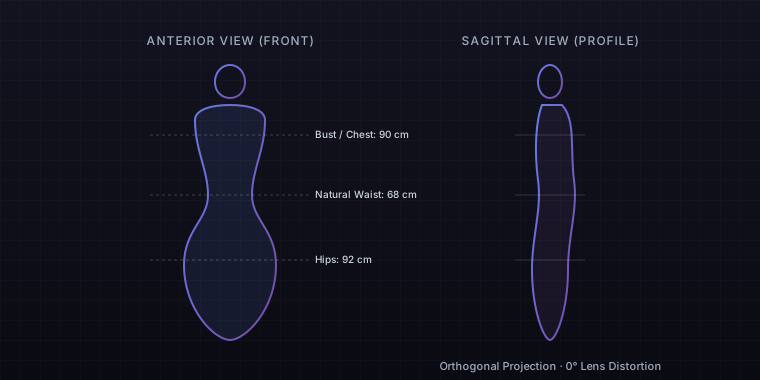
The preview generates a parametric silhouette calculated from biomechanical cross-sections. Instead of applying generic illustrative cutouts, the engine blends thoracic width, pelvic flare, and waist concavity to present proportional mass distribution from front and side angles.
Orthogonal front and side silhouette projections illustrating dimensional ratios without lens distortion.
How to Use the Body Visualizer
1Select your preferred measurement system and enter your baseline height and weight.
2Open the optional precision panel to input your bust, natural waist, and widest hip circumferences.
3Review your rendered silhouette, inspect calculated waist-to-hip ratios, and toggle comparative body archetypes.
Female Body Visualizer
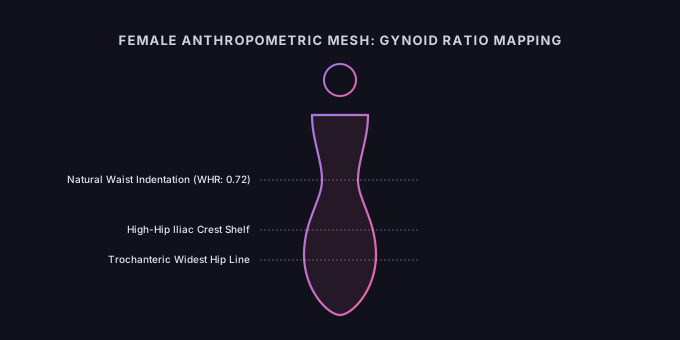
The female body visualizer configures geometric silhouette contours specifically around gynoid adipose patterns, pelvic inclination, and waist transitions. Standard apparel tables assume proportional scaling between bust, waist, and hips, yet female physiques exhibit diverse skeletal frame dimensions and distinct waist-hip drop differentials.
Unlike the generalized baseline mode, this configuration sharpens the transition between the lower ribcage and the iliac crest, preventing the vertical blockiness common in generic body shape visualizer utilities. It recalculates lateral curves to reflect pelvic tilt, high-hip shelf development, and gluteal depth rather than simple circumferences.
Primary Application: Selecting structured formalwear, evening dresses, or fitted suiting where high-hip placement and bust-to-waist ratios determine whether garments pucker across the abdomen or gap at the lower spine.
Parametric simulation illustrating female high-hip contouring and bust-to-waist ratios.
Female Mode Technical Specifications
How does this mode calculate bust projection versus ribcage circumference?
The engine splits circumference into transverse and anteroposterior diameters, rendering pectoral depth separately from ribcage breadth to avoid tubular distortions.
Can this model differentiate high-hip flare from lower-hip fullness?
Yes. Inputting high-hip circumference isolates pelvic shelf contouring from femoral wideness, distinguishing high-waisted shelf profiles from tapered lower-hip shapes.
Male Body Visualizer
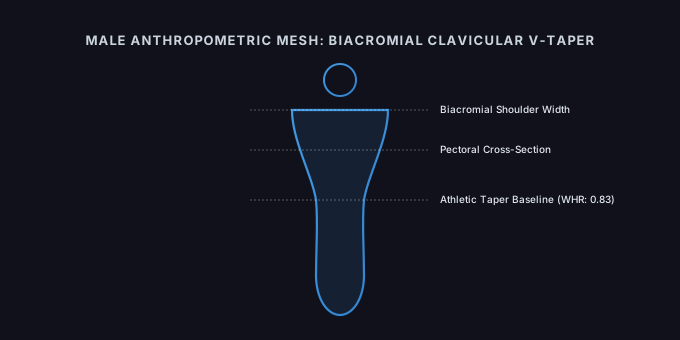
The male body visualizer constructs an upper-torso-dominant silhouette aligned with android fat distribution patterns, clavicular expansion, and ribcage geometry. Traditional sizing charts frequently misrepresent athletic male builds by assuming that wider chest measurements always correlate with wider waistbands.
Unlike the default configuration, this masculine body visualizer mode expands the biacromial diameter, reduces pelvic flare angles, and sharpens latissimus dorsi taper angles. The algorithms redistribute mass toward the upper thoracic envelope and lower abdominal baseline rather than the hips or outer thighs, producing a biomechanically realistic frame.
Primary Application: Evaluating upper-body athletic hypertrophy and shoulder-to-waist ratios for performance apparel, ensuring compression wear and tailored dress shirts accommodate shoulder breadth without excess fabric around the core.
Biomechanical model displaying male clavicular width and latissimus taper geometry.
Male Mode Technical Specifications
How does the model represent chest broadness without breast tissue curvature?
The algorithmic cross-section flattens anterior curvature and widens the clavicular span, projecting mass across the pectoral plate and upper back.
What happens when abdominal measurements exceed the chest measurement?
The simulation shifts mass distribution downward to the lower umbilical line, rendering the android abdominal contour typical of central adiposity while maintaining skeletal shoulder width.
Body Preview from Different Angles
Front and profile views provide complementary perspectives that a single forward-facing outline obscures. While an anterior silhouette shows shoulder breadth and waist indentations, side-angle projections reveal spinal posture, torso thickness, and pelvic alignment.
Switching between orthogonal front and side silhouettes allows you to evaluate how mass distributes along both lateral and profile axes. Instead of relying on a single flat index, this multi-angle visualizer functions alongside your calculated proportions to demonstrate how torso depth influences garment drape and overall posture.
Primary Application: Evaluating profile posture and garment fit along the back and torso, confirming whether jacket vents or high-rise waistbands will lay flat across the lower spine and hips.
Why does the profile view reveal different proportions than a front-facing mirror?
A front mirror only highlights lateral silhouette width. Profile projections display spinal alignment and torso thickness, clarifying how posture impacts perceived midsection shape.
How does comparing front and side views expand on a standard visualizer?
Standard single-angle visualizers flatten body contours into one plane; dual-angle silhouettes display width and profile contours side-by-side to clarify actual garment drape.
Body Simulator
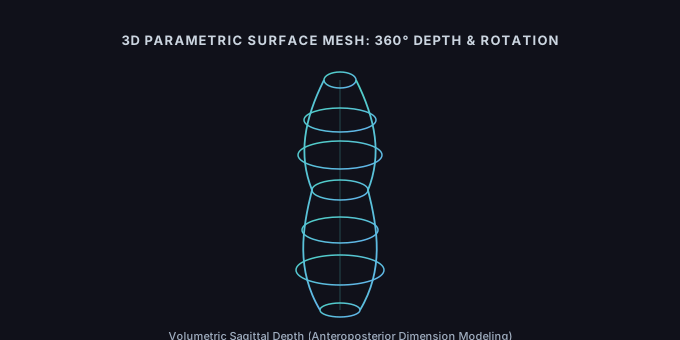
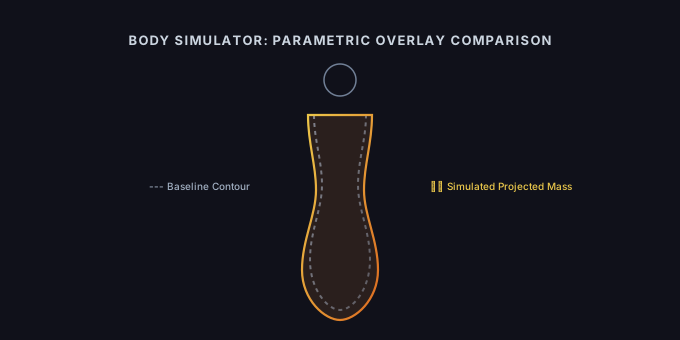
The body simulator functions as an interactive anthropometric sandbox, allowing dynamic adjustment of mass, stature, and segmental circumferences to observe structural changes. Static charts capture where your measurements stand today, but they cannot demonstrate how prospective shifts alter your overall balance.
Unlike fixed diagnostic screens, this body measurement simulator decouples skeletal bounds from soft tissue distribution. Adjusting the weight slider while locking shoulder and pelvic widths reveals whether added mass exaggerates a pear outline, squares off a waistline, or preserves an hourglass proportion based on your individual base ratios.
Primary Application: Planning bespoke tailoring modifications and seasonal wardrobe adjustments by testing how small circumference shifts across the waist or chest impact total silhouette balance before altering expensive fabrics.
Dynamic parameter shift overlay illustrating proportional changes under modified mass assumptions.
Simulator Mode Technical Specifications
Does the simulator predict exact fat loss locations?
No. Biological adipose reduction is genetically determined and systemic; the simulator demonstrates proportional geometric shifts rather than metabolic spot reduction.
Can I simulate historical measurements saved in past entries?
Yes. Entering older records into the body measurement simulator displays a comparative overlay, contrasting past structural ratios against your current shape.
Frequently Asked Questions
Do I need a flexible measuring tape to use this tool?
No. You can generate an immediate baseline model using only your height and weight. If you have a soft measuring tape, expanding the optional panel to include bust, waist, and hip circumferences calibrates the torso curves and regional fat distribution to reflect your actual frame.
How accurate is the body visualizer?
The visualizer relies on parametric anthropometric modeling. It maps entered dimensions to human morphological archetypes and geometric cross-sections. While it reliably reflects waist-to-hip ratios, shoulder breadth, and overall mass balance, it models surface outlines rather than internal bone density, localized muscle insertion points, or visceral fat.
Is my personal measurement data stored or uploaded?
No. All calculations, silhouette rendering, and ratio processing occur entirely within your local browser sandbox via client-side JavaScript. No measurement inputs, device data, or generated body models are transmitted to external servers or logged in databases.
How is this visualizer different from a standard BMI calculator?
A standard BMI calculator reduces your physique to a single numerical index derived from height and weight, failing to distinguish between muscle mass and adipose distribution. This visualizer pairs stature and mass with dimensional ratios to construct an interactive silhouette, rendering how weight distributes across the frame.
Can this tool function as a body weight visualizer or body maker for fitness targets?
Yes. By adjusting weight while holding height and skeletal frame constant, the simulator displays predicted volume expansion or reduction across primary storage areas. It serves as an anthropometric simulation rather than an imaging system, demonstrating geometric distribution changes without predicting localized spot reduction.
What should I do if my visual shape looks different from my calculator category?
Classification formulas categorize body shapes based on strict threshold deltas between bust, waist, and hips. In contrast, visual perception accounts for vertical proportions, pelvic bone angle, ribcage depth, and posture. Comparing the visual silhouette alongside numerical ratios clarifies how skeletal structure and soft tissue interact.